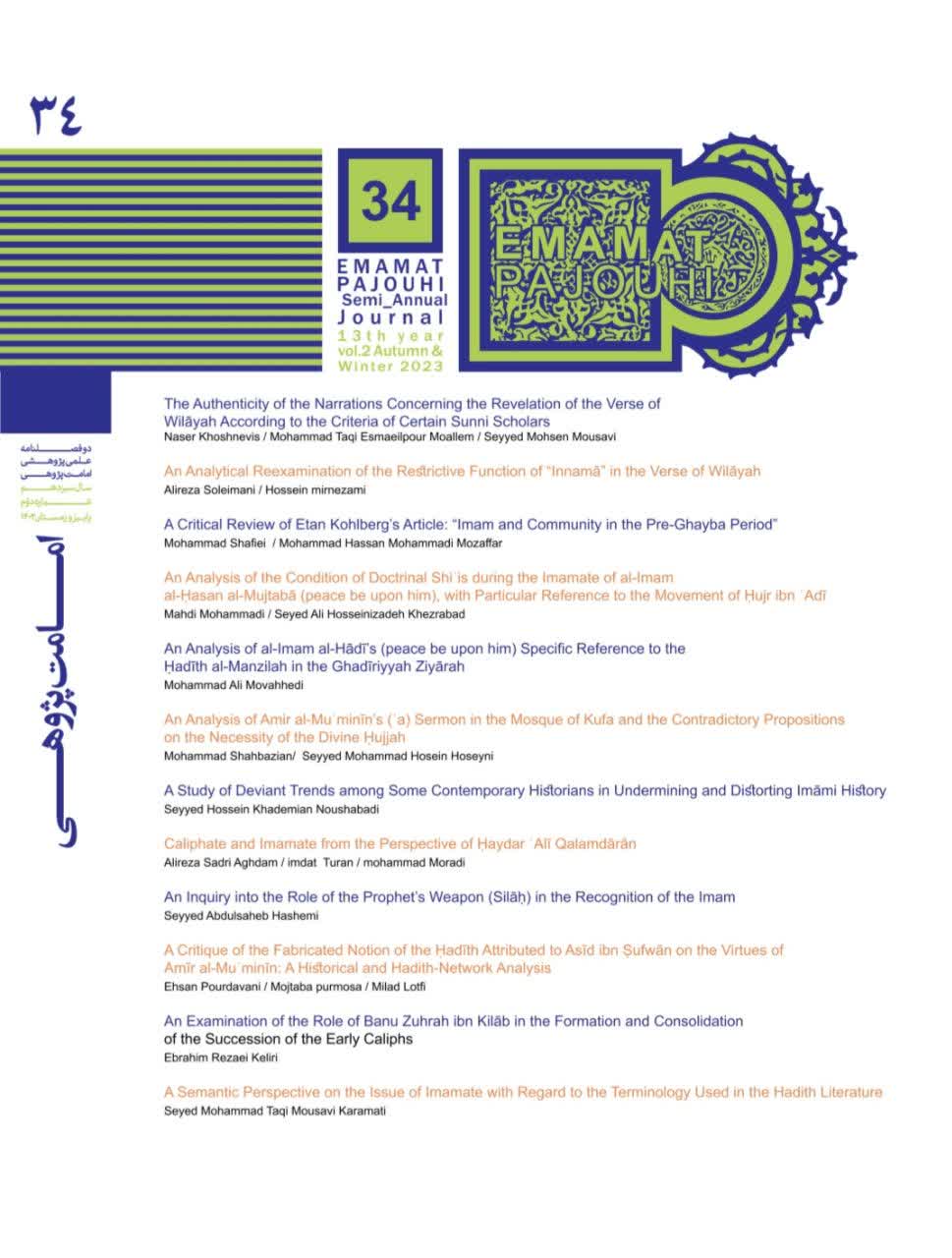
Innama is a frequent Arabic particle of restriction in the Qur'an. Some exegetes and theologians question its restrictive force in Qur'an 5:55, thereby disputing the verse's proof of Imam Ali's (A.S.) wilaya after the Messenger of God (P.B.U.H.). Denying restriction in innama, some generalize the verse to all believers and interpret wali merely as friend or helper. Using a descriptive-analytical method and a critical approach, this study evaluates views on innama and its restrictive function in Qur'an 5:55. It draws on lexicography, grammar, rhetoric, legal theory, and exegesis to identify the conventional meaning understood by the verse's first audience. Having established a restrictive meaning, the study argues that, although absolute restriction may obtain under certain conditions, the evidence here more strongly supports relative restriction.
Soleimani, A. & Soleimani, H. (2024). An Analytical Reassessment of the Restrictive Force of 'Innama' in the Verse of Wilaya. Emamat Pajouhi, 13(2), 38-66. https://doi.org/10.22034/jep.2026.531908.1668
MLA
Soleimani, A., & Soleimani, H. "An Analytical Reassessment of the Restrictive Force of 'Innama' in the Verse of Wilaya", Emamat Pajouhi, 13, 2, 2024, 38-66. doi: 10.22034/jep.2026.531908.1668
HARVARD
Soleimani A., Soleimani H. (2024). 'An Analytical Reassessment of the Restrictive Force of 'Innama' in the Verse of Wilaya', Emamat Pajouhi, 13(2), pp. 38-66. doi: 10.22034/jep.2026.531908.1668
CHICAGO
A. Soleimani & H. Soleimani, "An Analytical Reassessment of the Restrictive Force of 'Innama' in the Verse of Wilaya," Emamat Pajouhi, 13 2 (2024): 38-66, doi: 10.22034/jep.2026.531908.1668
VANCOUVER
Soleimani A., Soleimani H. An Analytical Reassessment of the Restrictive Force of 'Innama' in the Verse of Wilaya. Emamat Pajouhi. 2024;13(2):38-66 (In Persian). doi: 10.22034/jep.2026.531908.1668